5 Week 5: Scaling Techniques (Unsupervised Learning I)
Slides
- 6 Scaling Techniques and Topic Modeling (link to slides)
5.2 Wordfish
Slapin and Proksch (2008) propose an unsupervised scaling model that places texts on a one-dimensional scale. The underlying assumption is that
\[w_{ik} \sim \text{Poisson}(\lambda_{ik})\] \[\lambda_{ik} = \exp(\alpha_i + \psi_k + \beta_k \times \theta_i)\]
Here, \(\lambda_{ik}\) is generated by \(\alpha_i\) (the “loquaciousness” of politician \(i\), or document fixed effects), \(\psi_k\) (the baseline frequency of word \(k\)), \(\beta_k\) (the discrimination parameter of word \(k\)), and—most importantly, \(\theta_i\) (the politician’s ideological position). Let’s believe, for a moment, that the peer-review system works and use the textmodel_wordfish() function to estimate the ideological positions of U.S. presidents using their inaugural speeches.
## # A tibble: 6 × 4
##   inaugSpeech            Year President party
##   <chr>                 <dbl> <chr>     <chr>
## 1 "My Countrymen, It a…  1853 Pierce    Demo…
## 2 "Fellow citizens, I …  1857 Buchanan  Demo…
## 3 "Fellow-Citizens of …  1861 Lincoln   Repu…
## 4 "Fellow-Countrymen:\…  1865 Lincoln   Repu…
## 5 "Citizens of the Uni…  1869 Grant     Repu…
## 6 "Fellow-Citizens:\r\…  1873 Grant     Repu…
The text is pretty clean, so we can convert it into a corpus object, then into a dfm, and apply textmodel_wordfish():
corpus_us_pres <- corpus(us_pres,
                     text_field = "inaugSpeech",
                     unique_docnames = TRUE)

summary(corpus_us_pres)
## Corpus consisting of 41 documents, showing 41 documents:
##
## Text Types Tokens Sentences Year
## text1 1164 3631 104 1853
## text2 944 3080 89 1857
## text3 1074 3992 135 1861
## text4 359 774 26 1865
## text5 484 1223 40 1869
## text6 551 1469 43 1873
## text7 830 2698 59 1877
## text8 1020 3206 111 1881
## text9 675 1812 44 1885
## text10 1351 4720 157 1889
## text11 821 2125 58 1893
## text12 1231 4345 130 1897
## text13 854 2437 100 1901
## text14 404 1079 33 1905
## text15 1437 5822 158 1909
## text16 658 1882 68 1913
## text17 548 1648 59 1917
## text18 1168 3717 148 1921
## text19 1220 4440 196 1925
## text20 1089 3855 158 1929
## text21 742 2052 85 1933
## text22 724 1981 96 1937
## text23 525 1494 68 1941
## text24 274 619 27 1945
## text25 780 2495 116 1949
## text26 899 2729 119 1953
## text27 620 1883 92 1957
## text28 565 1516 52 1961
## text29 567 1697 93 1965
## text30 742 2395 103 1969
## text31 543 1978 68 1973
## text32 527 1364 52 1977
## text33 902 2772 129 1981
## text34 924 2897 124 1985
## text35 795 2667 141 1989
## text36 642 1833 81 1993
## text37 772 2423 111 1997
## text38 620 1804 97 2001
## text39 773 2321 100 2005
## text40 937 2667 110 2009
## text41 814 2317 88 2013
## President party
## Pierce Democrat
## Buchanan Democrat
## Lincoln Republican
## Lincoln Republican
## Grant Republican
## Grant Republican
## Hayes Republican
## Garfield Republican
## Cleveland Democrat
## Harrison Republican
## Cleveland Democrat
## McKinley Republican
## McKinley Republican
## T Roosevelt Republican
## Taft Republican
## Wilson Democrat
## Wilson Democrat
## Harding Republican
## Coolidge Republican
## Hoover Republican
## FD Roosevelt Democrat
## FD Roosevelt Democrat
## FD Roosevelt Democrat
## FD Roosevelt Democrat
## Truman Democrat
## Eisenhower Republican
## Eisenhower Republican
## Kennedy Democrat
## Johnson Democrat
## Nixon Republican
## Nixon Republican
## Carter Democrat
## Reagan Republican
## Reagan Republican
## Bush Republican
## Clinton Democrat
## Clinton Democrat
## Bush Republican
## Bush Republican
## Obama Democrat
## Obama Democrat
# We do the whole tokenization sequence
toks_us_pres <- tokens(corpus_us_pres,
                   remove_numbers = TRUE, # Thinks about this
                   remove_punct = TRUE, # Remove punctuation!
                   remove_url = TRUE) # Might be helpful

toks_us_pres <- tokens_remove(toks_us_pres,
                              # Should we though? See Denny and Spirling (2018)
                              c(stopwords(language = "en")),
                              padding = F)

toks_us_pres <- tokens_wordstem(toks_us_pres, language = "en")

dfm_us_pres <- dfm(toks_us_pres)

wfish_us_pres <- textmodel_wordfish(dfm_us_pres, dir = c(28,30)) #Does not really matter what the starting values are, they just serve as anchors for the relative position of the rest of the texts. In this case, I chose Kennedy and Nixon.
summary(wfish_us_pres)
##
## Call:
## textmodel_wordfish.dfm(x = dfm_us_pres, dir = c(28, 30))
##
## Estimated Document Positions:
## theta se
## text1 -0.95665 0.03617
## text2 -1.27089 0.03410
## text3 -1.40939 0.02859
## text4 -0.37234 0.08905
## text5 -1.19393 0.05613
## text6 -0.98790 0.05745
## text7 -1.25066 0.03678
## text8 -1.15849 0.03504
## text9 -1.06976 0.04863
## text10 -1.37040 0.02598
## text11 -1.09564 0.04334
## text12 -1.36373 0.02715
## text13 -0.96928 0.04390
## text14 0.14923 0.07992
## text15 -1.67179 0.01837
## text16 0.04315 0.05968
## text17 -0.14887 0.06481
## text18 -0.23081 0.04050
## text19 -0.64288 0.03619
## text20 -0.81708 0.03635
## text21 -0.26568 0.05470
## text22 0.26552 0.05564
## text23 0.56605 0.06544
## text24 0.82801 0.09576
## text25 0.09672 0.04999
## text26 0.37474 0.04777
## text27 0.60860 0.05653
## text28 0.92076 0.05652
## text29 0.96033 0.05604
## text30 1.42553 0.03773
## text31 0.93186 0.05098
## text32 0.87530 0.06217
## text33 1.13366 0.04085
## text34 1.19922 0.03746
## text35 1.25258 0.03978
## text36 1.38319 0.04373
## text37 1.38027 0.03681
## text38 0.87024 0.05416
## text39 0.74125 0.04862
## text40 1.18890 0.03947
## text41 1.05104 0.04446
##
## Estimated Feature Scores:
## countrymen relief feel heart
## beta -0.5492 -0.9578 -0.4907 0.80563
## psi -0.5455 -1.8436 -0.3948 0.08719
## can know person regret bitter
## beta 0.1395 0.9421 -0.1118 -0.2535 0.003517
## psi 2.1154 0.6955 -0.1544 -2.8010 -2.019466
## sorrow born posit suitabl other
## beta 0.5177 0.7627 -0.9822 -4.124 0.3934
## psi -2.0333 -0.8260 -1.2127 -6.138 0.1718
## rather desir circumst call
## beta 0.005341 -0.6215 -0.6367 0.3746
## psi -0.591945 -0.5405 -1.3629 0.5610
## limit period presid destini
## beta -0.07383 -0.004653 0.4892 0.2600
## psi -0.02468 -1.040491 0.4727 -0.2598
## republ fill profound sens
## beta -0.27116 0.6825 -0.05042 -0.1159
## psi 0.08107 -1.6843 -1.52207 -0.2338
## respons noth like shrink
## beta 0.2266 -0.08426 0.01539 0.169
## psi 0.8392 -0.25097 0.19869 -1.708Let’s see whether this makes any sense. Since we know each president’s party, we would expect Republican presidents to cluster together and separate from Democrats (or something along those lines):
# Get predictions:
wfish_preds <- predict(wfish_us_pres, interval = "confidence")

# Tidy everything up:
posi_us_pres <- data.frame(docvars(corpus_us_pres),
                      wfish_preds$fit) %>%
  arrange(fit)

# Plot
posi_us_pres %>%
  ggplot(aes(x = fit, y = reorder(President,fit), xmin = lwr, xmax = upr, color = party)) +
  geom_point(alpha = 0.8) +
  geom_errorbarh(height = 0) +
  labs(x = "Position", y = "", color = "Party") +
  scale_color_manual(values = wes_palette("BottleRocket2")) +
  theme_minimal() +
  ggtitle("Estimated Positions")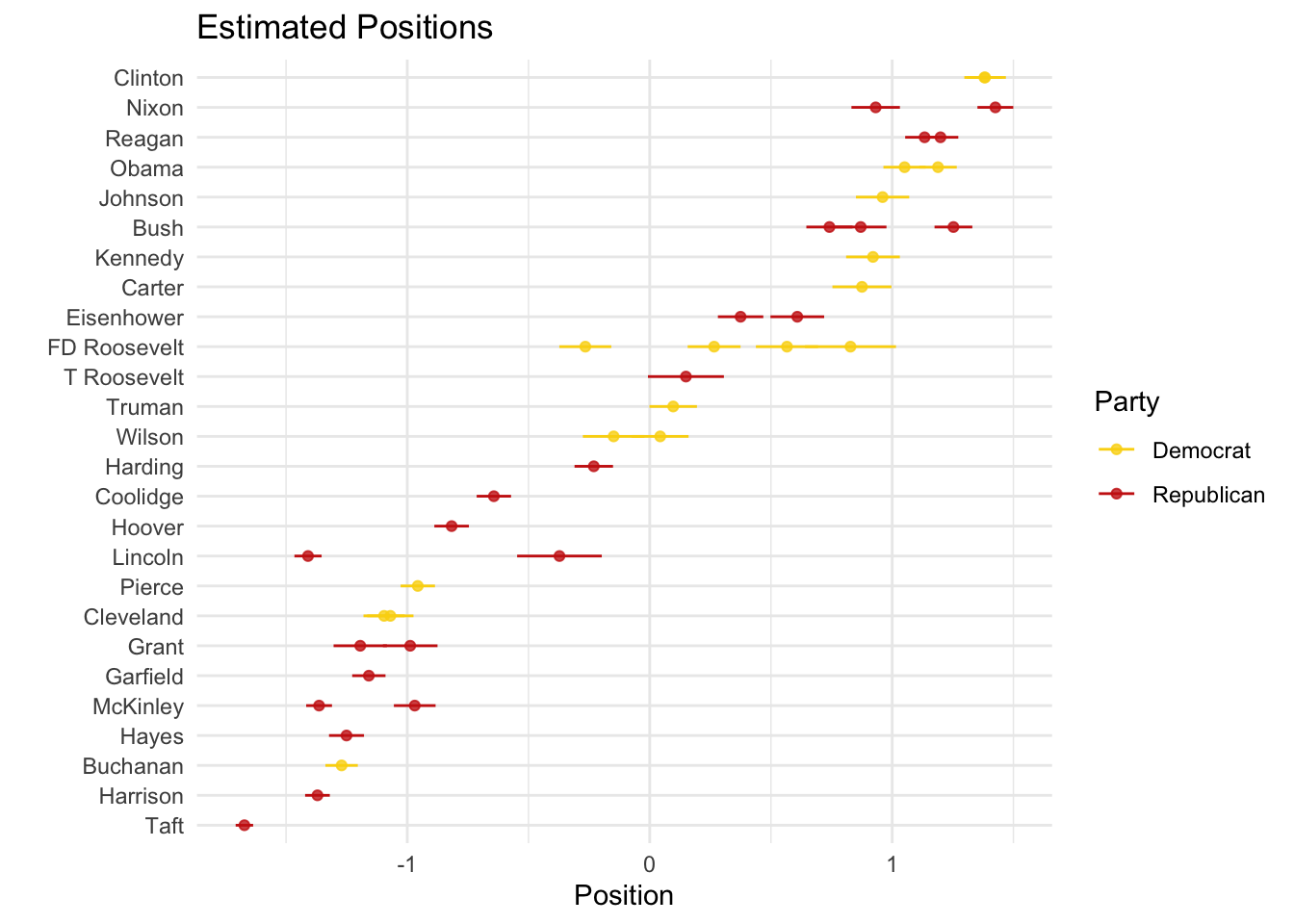
Two things to note. First, the direction of the scale is a theoretically grounded decision that the researcher has to make (not the algorithm). In our case, based on these results, we could interpret positive values as more left-leaning and negative values as more right-leaning. For visualization purposes, we can flip the direction simply by multiplying by -1:
# Plot inverse
posi_us_pres %>%
  ggplot(aes(x = -fit, y = reorder(President,fit), xmin = -lwr, xmax = -upr, color = party)) +
  geom_point(alpha = 0.8) +
  geom_errorbarh(height = 0) +
  labs(x = "Position", y = "", color = "Party") +
  scale_color_manual(values = wes_palette("BottleRocket2")) +
  theme_minimal() +
  ggtitle("Estimated Positions")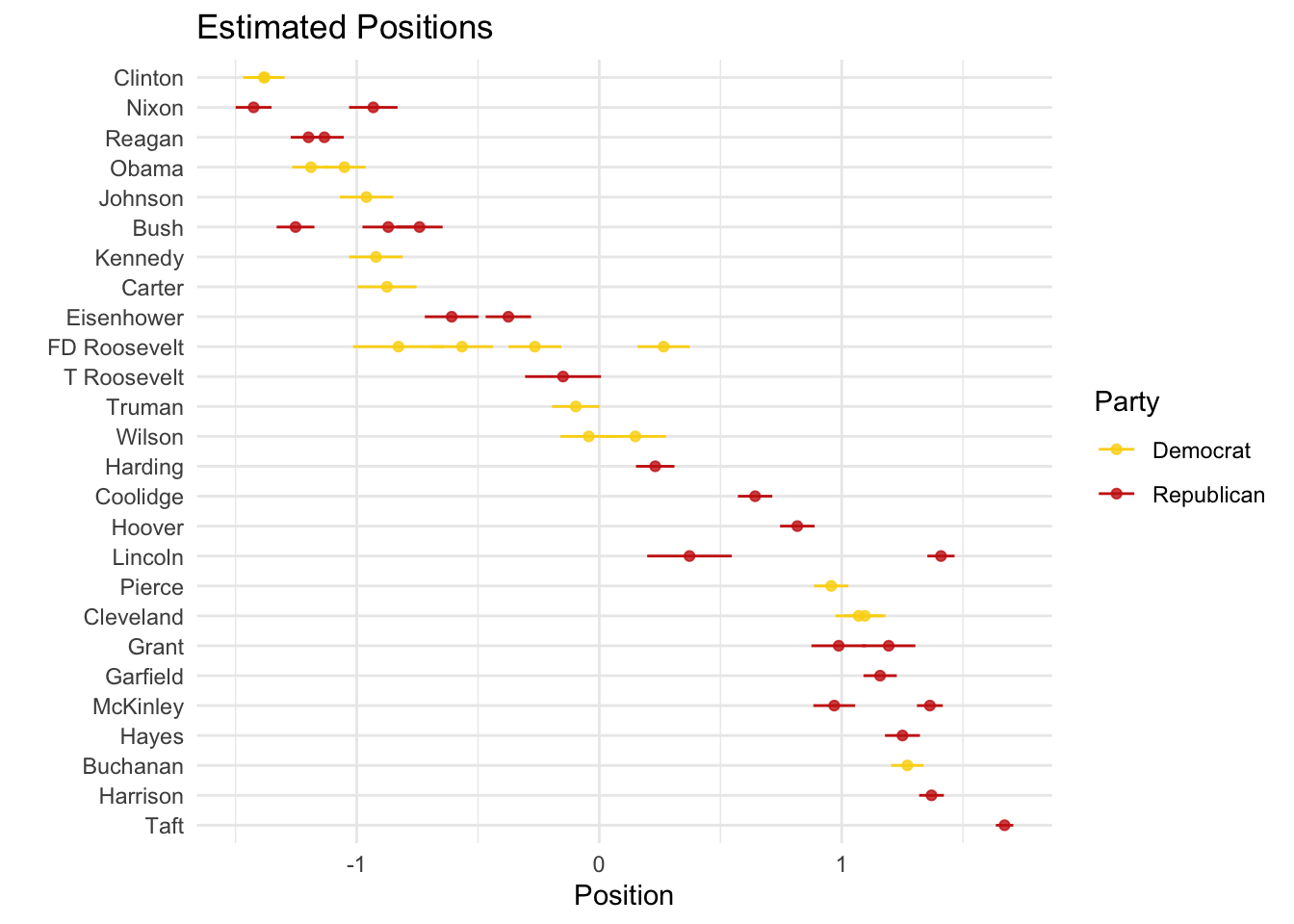
Second, there seems to be a mismatch between our theoretical expectations and our empirical observations. We might assume that Republicans (Democrats) would talk more similarly to other Republicans (Democrats) and differently from Democrats (Republicans). However, that is not what we see here. What could be happening?
One possibility is that language changes over time, issues change over time, or even what it means to be a Democrat or Republican changes over time. and the model is picking up that temporal shift:
# Plot time
posi_us_pres %>%
  ggplot(aes(y = -fit, x = Year, ymin = -lwr, ymax = -upr, color = party)) +
  geom_point(alpha = 0.8) +
  geom_errorbar() +
  labs(x = "Year", y = "Position", color = "Party") +
  scale_color_manual(values = wes_palette("BottleRocket2")) +
  theme_minimal() +
  ggtitle("Estimated Positions")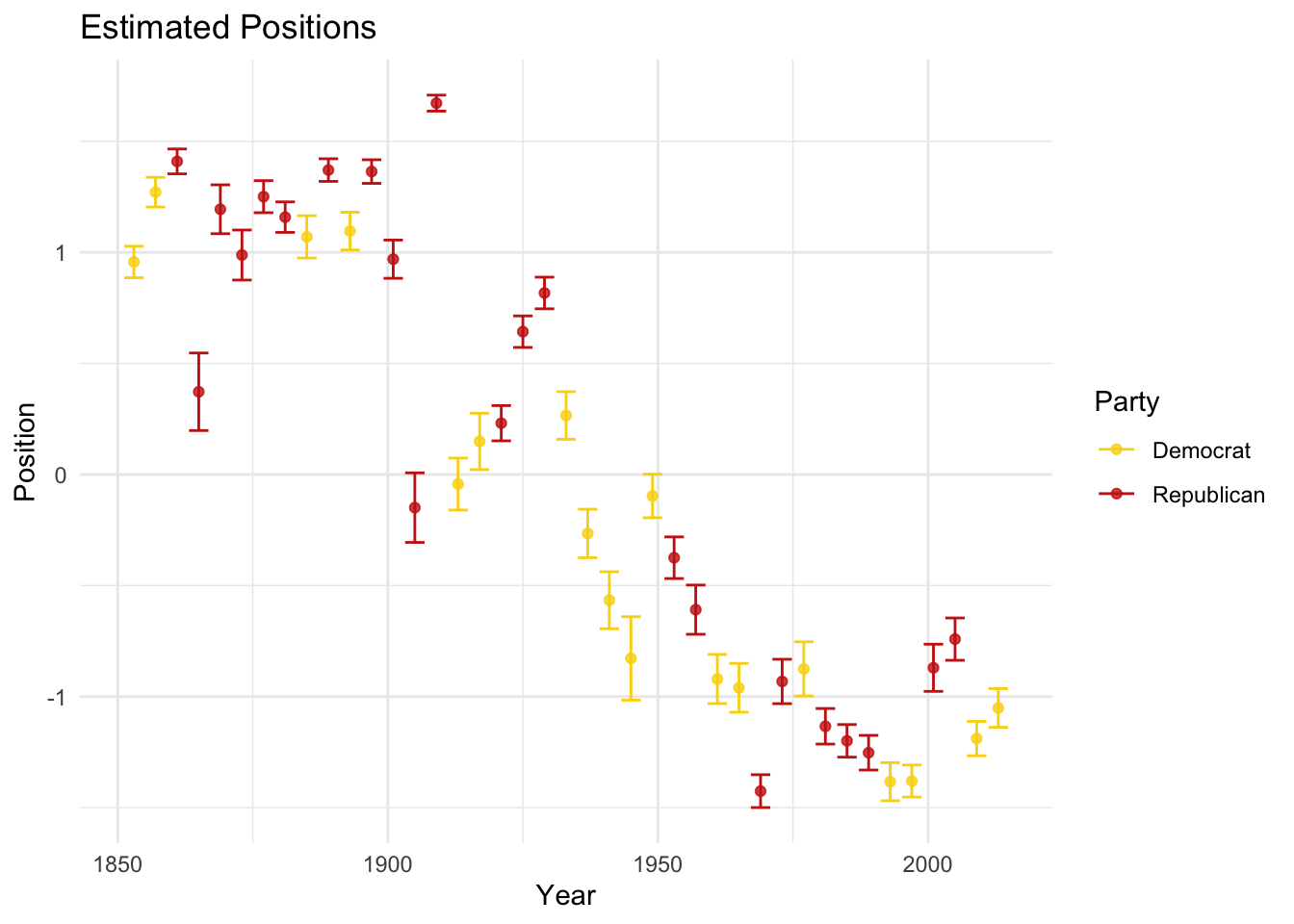
That seems like one possible explanation. Another is that our preprocessing steps substantively modified the texts (see Denny and Spirling 2018). We can estimate the model again using a differently preprocessed version of the text:
# Tokenization only removing punctuation
toks_us_pres2 <- tokens(corpus_us_pres,
                   remove_punct = TRUE)

dfm_us_pres2 <- dfm(toks_us_pres2)
wfish_us_pres <- textmodel_wordfish(dfm_us_pres2, dir = c(28,30))

# Get predictions:
wfish_preds <- predict(wfish_us_pres, interval = "confidence")

# Tidy everything up:
posi_us_pres <- data.frame(docvars(corpus_us_pres),
                      wfish_preds$fit) %>%
  arrange(fit)

# Plot
posi_us_pres %>%
  ggplot(aes(x = -fit, y = reorder(President,fit), xmin = -lwr, xmax = -upr, color = party)) +
  geom_point(alpha = 0.8) +
  geom_errorbarh(height = 0) +
  labs(x = "Position", y = "", color = "Party") +
  scale_color_manual(values = wes_palette("BottleRocket2")) +
  theme_minimal() +
  ggtitle("Estimated Positions (Minimal Pre-Processing)")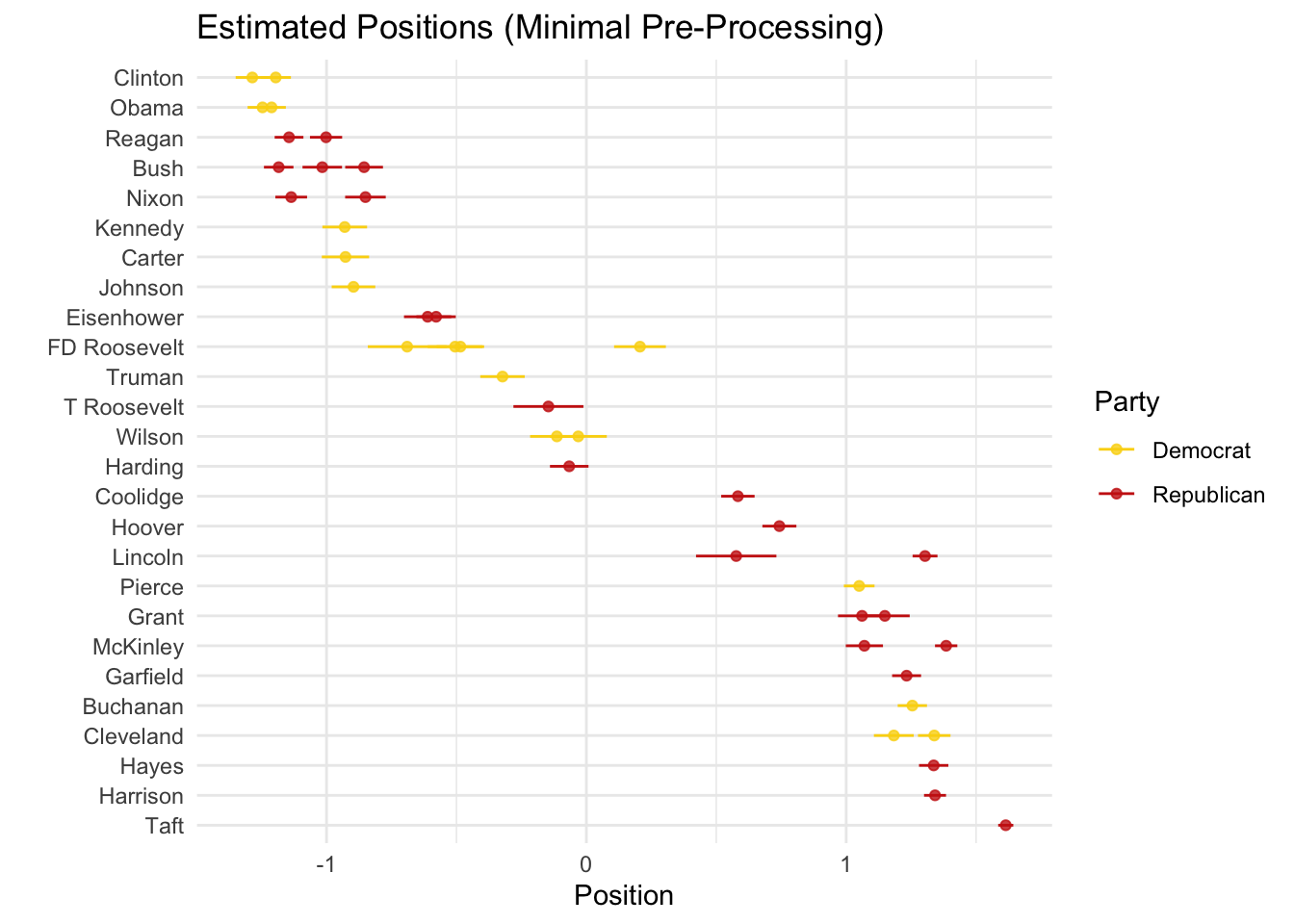
At the very least, the within president differences in estimates have narrowed, but time seems to still be the best predictor:
# Plot time
posi_us_pres %>%
  ggplot(aes(y = -fit, x = Year, ymin = -lwr, ymax = -upr, color = party)) +
  geom_point(alpha = 0.8) +
  geom_errorbar() +
  labs(x = "Year", y = "Position", color = "Party") +
  scale_color_manual(values = wes_palette("BottleRocket2")) +
  theme_minimal() +
  ggtitle("Estimated Positions (Minimal Pre-Processing)")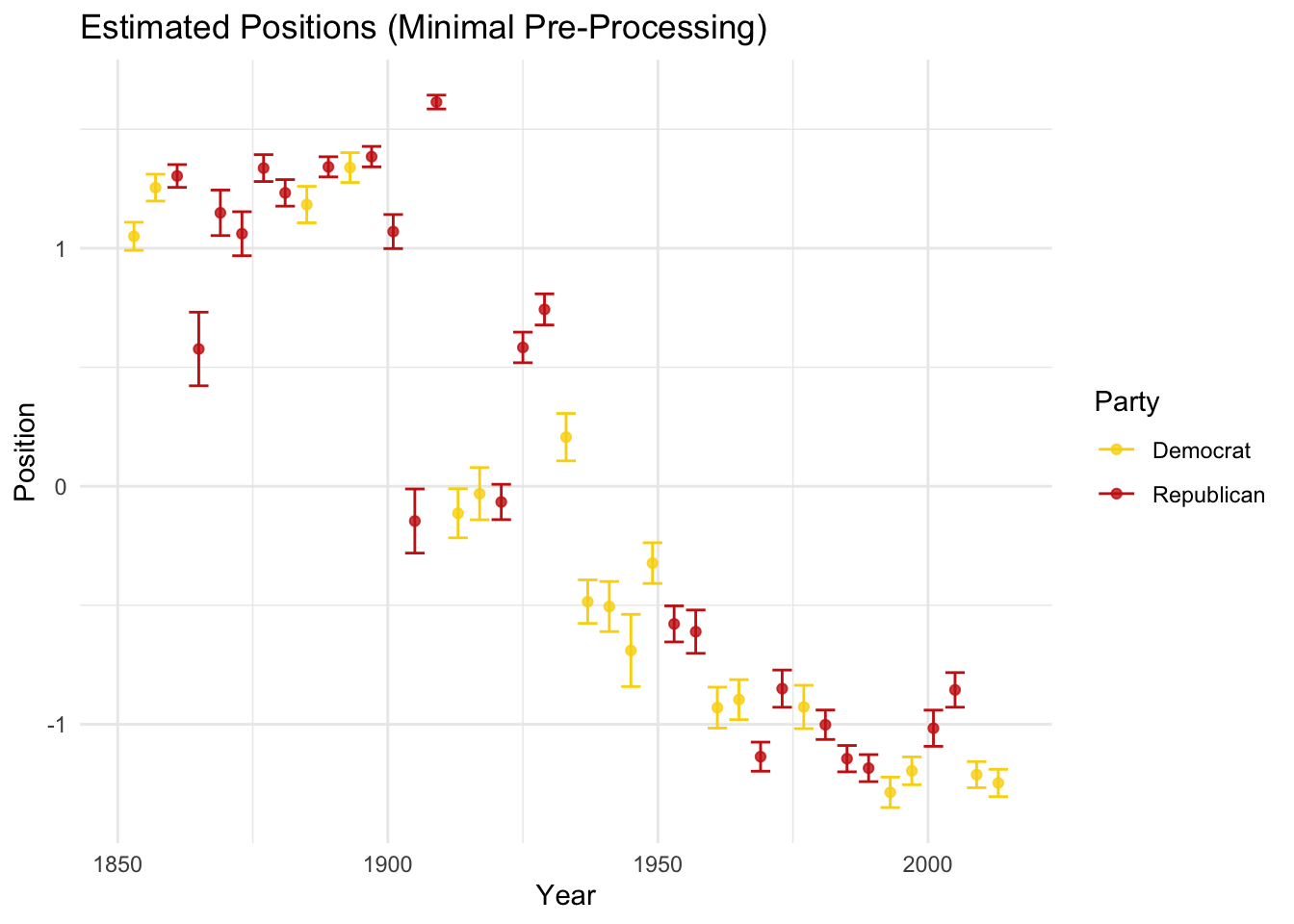
If time is the main predictor, then we may need to focus on periods that are more comparable across parties (e.g., the era after the Civil Rights Act).
5.3 Homework 2:
- We had a hard time scaling our text, so we looked at some possible problems. What are possible solutions if we want to position U.S. presidents on an ideological scale using text?
- Use the
data/candidate-tweets.csvdata to run an STM. Decide what your covariates are going to be. Decide whether you will use all the data or a sample of the data. Decide whether you are going to aggregate or split the text in some way (i.e., decide your unit of analysis). Decide the number of topics you will look for (try more than one option). What can you tell me about the topics tweeted by the 2015 U.S. primary candidates? - Choose three topics (see Week 6). Can you place the candidates on an ideological scale within each topic (determine the \(\theta\) threshold for when you can say that a tweet is mostly about a topic)? Does it make sense? Why or why not?